Israel’s climate crimes
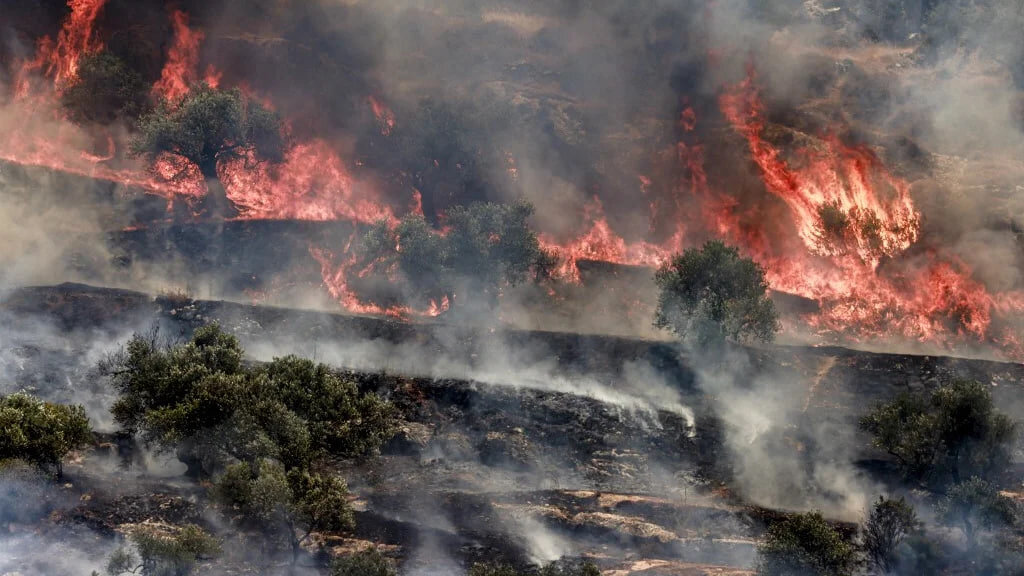
TEHRAN - Israel’s environmental damage in Palestine has accompanied the destruction of Palestinian lives, homes and livelihoods. Farmlands and olive groves have been burned or destroyed, while homes, vehicles, cities and refugee camps have been repeatedly bombarded.
The thick clouds of soot produced by the bombardment of Gaza have also raised alarm among environmentalists over the war’s devastating impact on the environment.
In September 2025, the Palestinian Institute for Climate Strategy, together with Tipping Point North South, estimated that Israel and its allies owed Palestinians $148 billion in military- and conflict-related climate reparations dating back to the Nakba. The estimate is based on the calculated climate costs of traceable military-related emissions and assigns $103 billion to Israel and $40.8 billion to the United States, with smaller amounts attributed to several European allies. The researchers stressed that the figure represents only a measurable portion of the broader environmental and social damage.
Israel’s burning of agricultural land and forests in southern Lebanon and the destruction of homes in villages and cities, including Beirut, have further compounded the environmental damage caused by the conflict.
The war on Gaza has also generated enormous greenhouse-gas emissions. A study published in One Earth in March 2026 estimated that direct emissions from the conflict exceeded 1.3 million tons of CO? equivalent by January 2025. When emissions associated with pre-war military infrastructure and post-war reconstruction are included, the estimate rises to 33.2 million tons of CO? equivalent. Reconstruction alone accounts for an estimated 31.4 million tons.
The environmental consequences, however, extend far beyond carbon emissions. The war has created serious risks for both the Mediterranean marine environment and Gaza’s groundwater system. The two problems are closely linked: the destruction of water and sanitation infrastructure has allowed pollutants from the land and underground water system to reach the Mediterranean.
The most immediate impact has been the enormous discharge of untreated sewage into the sea. Gaza’s wastewater-treatment system has largely collapsed. UNEP estimated that in March 2024, around 60,000 cubic meters of wastewater and sewage were being discharged into the environment every day, primarily into the Mediterranean.
This wastewater can carry pathogens and disease-causing microorganisms, nitrogen and phosphorus that contribute to eutrophication and oxygen depletion, microplastics, organic pollutants, industrial chemicals and other hazardous substances. Damaged infrastructure and military activity may also introduce heavy metals and other contaminants.
UNEP’s September 2025 assessment found that Gaza’s marine and coastal ecosystems had been contaminated by sewage, solid waste and munitions. However, it said the precise scale and chemical composition of the contamination could not yet be determined because adequate environmental sampling has been severely constrained.
The war has also devastated marine life and fisheries. Pollution threatens Gaza’s coastal ecosystems, fish stocks and other marine organisms. UNEP has said the conflict has virtually eliminated Gaza’s fishing livelihoods, while the destruction of environmental-management systems has made contamination of the seafood chain more difficult to control.
There is also a longer-term concern. If enormous quantities of war debris are dumped into the sea or used for land reclamation without proper sorting and treatment, asbestos, heavy metals, hydrocarbons and other contaminants could enter marine ecosystems and potentially the food chain.
The war has also placed Gaza’s Coastal Aquifer, the enclave’s principal natural freshwater resource, under severe additional pressure. This could prove to be one of the conflict’s most serious long-term environmental consequences.
The destruction of sewage networks and wastewater-treatment plants, combined with widespread reliance on cesspits, allows contaminated water to infiltrate the porous ground and reach the aquifer. UNEP’s 2025 assessment says groundwater contamination is likely and warns that the destruction of piped systems and increased reliance on cesspits have increased the risk of aquifer contamination.
Potential contaminants include sewage and pathogens, nitrates and other nutrients, chemicals, heavy metals, hydrocarbons, and pollutants associated with munitions and destroyed infrastructure.
Soil contamination has further aggravated the groundwater problem. The crisis is not simply a matter of sewage. The destruction of buildings has generated tens of millions of tons of rubble, while military activity has contaminated soil with munitions, solid waste and untreated sewage.
UNEP’s September 2025 assessment estimated that the destruction of some 78 percent of Gaza’s buildings had generated approximately 61 million tons of debris. It warned that around 15 percent of the debris could pose relatively high contamination risks because of asbestos, industrial waste and heavy metals if waste streams are not properly segregated.
Rainwater moving through contaminated soil and rubble can carry pollutants downward toward groundwater. At the same time, the destruction and compaction of soil have reduced its capacity to absorb water, increasing runoff and reducing groundwater recharge.
Seawater intrusion could become an even greater problem. Gaza’s aquifer was already being over-pumped before the war. Excessive groundwater extraction lowers freshwater levels and can allow Mediterranean seawater to penetrate the aquifer.
The war has severely damaged pumping, storage, desalination and wastewater systems, making it much more difficult to manage both groundwater depletion and contamination. UNEP’s assessment found extensive damage to Gaza’s water infrastructure and warned that the environmental consequences could persist for decades.
The environmental damage is therefore not necessarily confined to Gaza’s shoreline.
The Mediterranean is a semi-enclosed sea, and pollutants discharged from Gaza can be transported by currents and coastal circulation. The precise regional extent of contamination remains uncertain because environmental monitoring has been severely restricted. Scientific modeling has nevertheless examined how wastewater pollutants can disperse from Gaza’s coastal waters into the Mediterranean.
UNEP’s latest assessment warns that repairing the damage to Gaza’s water resources, soils, freshwater ecosystems and marine environment could take decades.
Israel’s environmental impact on Palestinian land also predates the current war. Palestinian environmental advocates have for years documented the destruction of agricultural land and restrictions affecting water and other natural resources. Among the practices cited by Palestinian environmental groups is the spraying of herbicides on agricultural areas in Gaza and the destruction of farmland.
Palestinian environmental advocates have also accused Israel of policies that systematically restrict Palestinian access to water resources. Najla Abdellatif, founder of Zero Waste Palestine, told Middle East Eye that she had met Palestinian farmers whose groundwater sources were affected by measures involving Israel’s state-run water company.
Taken together, the destruction of agricultural land, water and sanitation infrastructure, soil, coastal ecosystems and natural resources has created an environmental crisis whose consequences are likely to extend well beyond the end of the fighting.
Leave a Comment